Two green silhouettes lean into each other against a pale, almost washed-out sky, balanced on a bare branch that cuts across the top of the frame. At first glance it looks like a quarrel — beaks locked, bodies pressed forward — but the moment lingers too gently for that. The larger bird, with its crisp black and rose neck ring and bright orange eye, tilts its head with precision. The other leans in, receptive, almost tender. This is not a clash. It’s a quiet exchange.
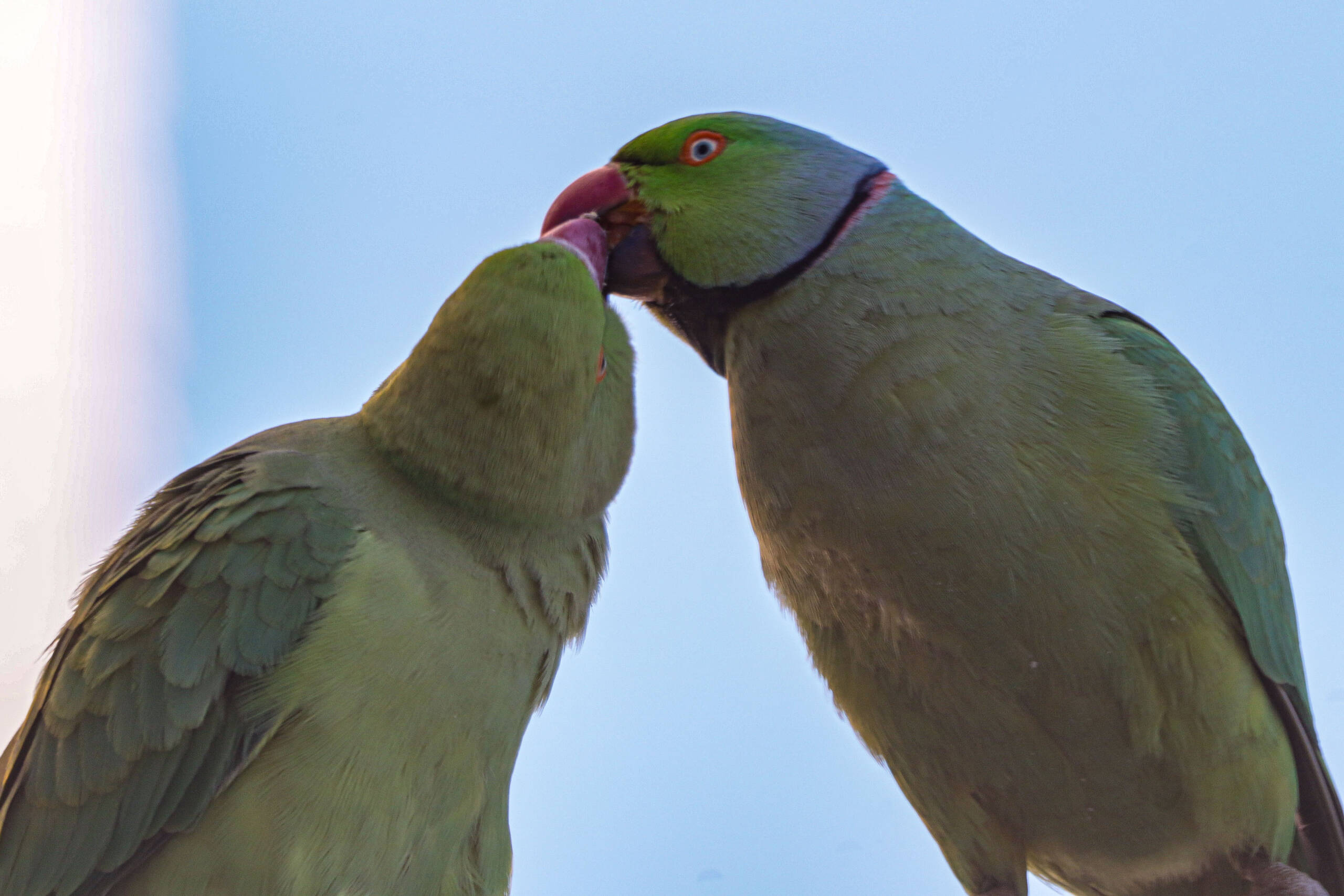
These are rose-ringed parakeets, and what we’re seeing is bonding behavior — often called billing or courtship feeding. The beaks touch, then overlap, and for a second it feels like a kiss. In reality, it’s more practical and more intimate at the same time. One bird, typically the male, regurgitates a bit of food to offer the other. It’s an act that says: I can provide. I choose you. Stay close.
The details matter. The feathers are smooth, not flared. The stance is steady, not defensive. There’s no tension in the wings. Even the eye of the ring-necked parakeet — sharp and pale with a dark pupil — carries focus rather than alarm. The entire scene is contained within that small contact point of two curved beaks meeting in midair.
It’s strange how something so biologically functional reads as affection to us. Maybe because it is affection, just expressed in a language without sentimentality. A transfer of food becomes a transfer of trust. On a thin branch, in open daylight, they rehearse partnership.
And then, just like that, it’s over. A step back. A shift of weight. The sky remains blank and quiet behind them, as if nothing at all happened.